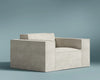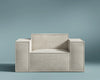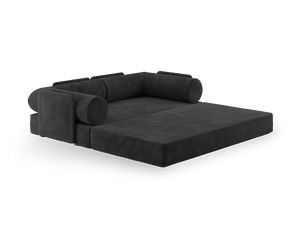
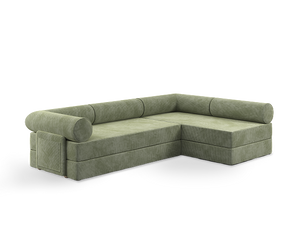

Quick answer: how is boneless furniture made?
Boneless furniture is built around a foam core instead of a wood or metal frame. The foam is shaped into modules, wrapped in a fabric cover, and compressed so it can ship in a compact box. When you open the box, the foam expands back into its full shape.
- The core: high-density foam that provides structure and comfort.
- The cover: a performance fabric that wraps each module.
- The connection: zippers that join the modules.
- The shipping: compression into easy-carry boxes.
Step 1: the foam core
Everything starts with the foam. In a framed sofa, the frame carries the weight and the foam only cushions.

In a boneless sofa, the foam does both jobs, so it has to be dense enough to support you and soft enough to be comfortable. If the term is new to you, begin with what boneless furniture is.
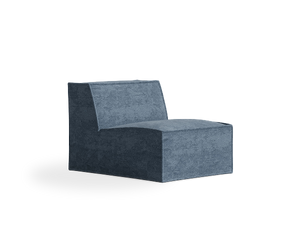
Rove Lab calls its version SmartFoam™, a proprietary high-density foam that is designed to keep its shape. Every M1 module is built entirely from it.
SmartFoam™ is not memory foam
Ordinary sofa foam is cushioning. It sits on top of a structure that someone else built, usually wood, metal, and springs. SmartFoam™ is the structure itself: it carries the load, holds the shape of the seat, the back, and the arms, and returns to that shape after being compressed to a fraction of its size.
That is also why memory foam is the wrong comparison. Memory foam is a slow-recovery cushioning material designed to sink and mould around your body. SmartFoam™ is designed to do the opposite: respond to your weight, support it, and come back.
| Feature | Memory foam | SmartFoam™ |
|---|---|---|
| Job on the sofa | Cushioning on top of a frame | Structure: it replaces the frame |
| Typical density | 50-90 kg/m³ | 34.8 kg/m³, engineered for structural support |
| Response to load | Slow recovery: sinks and holds the impression | Progressive: resistance rises with load and returns right away |
| Compressible for shipping | Not as a structural sofa | Yes, and it returns to its engineered shape |
| Airflow | Traps heat by design | Open-cell: air moves through the material |
How SmartFoam™ works: three behaviours built into the material
A foam that replaces a frame has to do three things at the same time, and keep doing them for years. SmartFoam™ is engineered around these three behaviours.
1. Adaptive cell structure. SmartFoam™ has an open-cell architecture. Each cell is a tiny structural member filled with air and connected to the cells around it. Because the cells are open, air moves through the material instead of being trapped, so the foam breathes rather than holding heat the way a closed-cell block does. When you sit, the load is not absorbed by one spot. It spreads across the surrounding cells, which is how a soft-feeling material can act like a structure. When you stand up, the cell walls return to the geometry they started with.
2. Progressive support curve. Comfort and support usually pull against each other. Soft foam feels good and gives up, and firm foam supports you but feels like a bench. SmartFoam™ solves this by making its resistance rise as the load increases. In lab testing, the same block pushes back with 231 N at 25% compression, 337 N at 50%, and 466 N at 65%. In everyday terms, it is soft at first touch, balanced when you sit, and firm when you lean all the way back. That is why one material can be both the cushion and the frame.
3. Expansion memory. A sofa that ships in a box has to survive something a traditional sofa never faces: being compressed to a fraction of its volume, staying that way for weeks in transit, and then being asked to be furniture again. SmartFoam™ is engineered to take the compression without permanent damage to the cell walls, and to return to the shape it was built to hold, not an approximation of it. This is what makes the box delivery in Step 4 possible.
What SmartFoam™ has been tested for
Rove Lab reports SGS laboratory testing from March 2026, using standards written for contract furniture, the kind used in airports and hotel lobbies.
| Standard | What it measures | Result |
|---|---|---|
| ASTM D3574-17 | Core density | 34.8 kg/m³ |
| IFD 25 / 50 / 65% | Progressive support under load | 231, 337, then 466 N |
| ASTM D4157 (Wyzenbeek) | Abrasion resistance of the cover | 70,000+ cycles |
| BIFMA | Impact and drop cycles, commercial grade | 100,000+ cycles |
| ISO 13935-1 | Seam strength | 1,088 N |
| ISO 14184-1 | Formaldehyde content | None detected |
The BIFMA impact protocol runs a seat through more than 100,000 cycles, which is the bar for furniture in airports, offices, and hotels. SmartFoam™ is also OEKO-TEX certified and 100% vegan, and Rove Lab says its compact boxes mean up to 6 times less carbon per shipment than bulky freight.
Want the full technical detail? Visit thesmartfoam.com for the science, the test data, and the full comparison with memory foam.
Step 2: layering for comfort

Some pieces add a second layer. The S8+ pairs SmartFoam™ with CloudMemory, a softer comfort layer designed to cushion your body. That combination is how a sofa that converts into a bed can still be comfortable to sit on and to sleep on.
In this Dual-Layer Comfort System, SmartFoam™ provides the flexible support and structure at the core, and CloudMemory adds adaptive softness and cushioning where you feel it.
Step 3: the cover
Once the foam has been shaped, it needs an outer layer. The fabric is carefully fitted around the foam, giving the sofa its finished look and feel. Beyond its appearance, the cover also helps protect the foam from everyday wear and tear.

Depending on the sofa design, different fabrics can add texture, softness, and practical features like spill resistance or removable, washable covers.
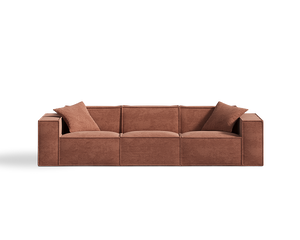
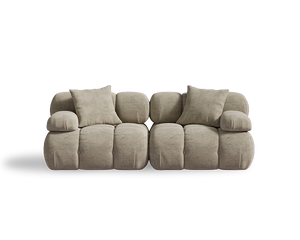
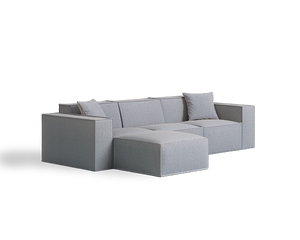
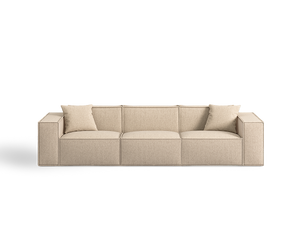
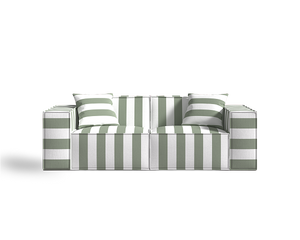
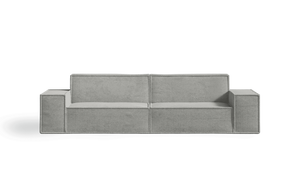
The M1 Sofa, for example, is upholstered in Performance Weave, a spill-resistant, OEKO-TEX certified fabric that is tested to exceed 100,000 double rubs. The Marshbello also comes in Chatou Boucle and Shearling, and the S8+ in Performance Corduroy with a removable, machine-washable cover.
Step 4: compression and the box
Because there is no frame, each module can be compressed. Rove Lab describes using a 10-ton press to condense the sofa into its packaging. The compressed modules ship in easy-carry boxes, so you can bring them through narrow doors, stairs, and elevators.

This is where SmartFoam™'s expansion memory does its job, because the foam has to take the squeeze without losing its engineered shape. Open the box and the foam expands. Allow up to 48 hours for it to fully expand and firm up.

Step 5: zippers and stability
Without a traditional wood or metal frame holding everything together, the modules need a secure connection to stay in place and create a stable seating surface. That's where YKK zippers come in.

They connect the modules firmly, helping prevent them from shifting apart during everyday use. And when you want to change your layout, move your sofa, or add more pieces, simply unzip the modules and separate them. It's what makes a boneless sofa truly modular: easy to connect, rearrange, and adapt to your space.
The M1 also includes an anti-slip pad and a dust cover for added stability and protection.
FAQ - Frequently Asked Questions
What is inside a boneless sofa?
A boneless sofa is built around a high-density foam core instead of a traditional wood or metal frame. The foam provides the structure, shape, and support, while an outer fabric cover protects it and gives the sofa its finished look. Some designs, like the Rove Lab S8+, also include an additional comfort layer for a softer feel.
How does a boneless sofa support your weight without a frame?
The high-density foam does the job normally handled by a traditional frame. It's engineered to provide progressive support, meaning its resistance increases as more weight is applied. This helps the sofa maintain its shape and support your body without relying on wood, metal, or springs.
Is SmartFoam™ the same as memory foam?
No. While both are foam materials, they serve different purposes. Memory foam is typically used as a cushioning layer that contours to your body and recovers slowly. SmartFoam™ is designed to act as the sofa's structural core, providing support, holding its shape, and recovering after compression.
How dense is SmartFoam™?
SmartFoam™ has a core density of 34.8 kg/m³, measured according to the ASTM D3574-17 standard in SGS laboratory testing. This density is part of what allows the foam to provide the support and structure needed for a boneless sofa.
Does the foam breathe?
SmartFoam™ has an open-cell structure, so air moves through the material instead of being trapped.
Why does the foam expand after unboxing?
Rove Lab compresses its foam modules to make shipping easier and reduce the space they take up in transit. Once you remove the packaging, the foam gradually returns to its intended shape. Allow up to 48 hours for it to fully expand and firm up.
Is the foam vegan?
Rove Lab describes SmartFoam™ as 100% vegan.
How are the modules held together?
Rove Lab uses YKK zippers to connect individual modules and help keep them securely in place during everyday use. When you want to rearrange your sofa, move it, or change its configuration, simply unzip the connections and separate the pieces.
Can you rearrange or add modules to a boneless sofa?
Yes, modular designs make it easy to change your layout as your space or needs evolve. You can separate individual pieces, rearrange them, or add compatible modules to create a different configuration. The available combinations depend on the sofa collection.
Keep reading
- What is boneless furniture? A guide to frame-free design.
- How long boneless furniture lasts: foam, fabric, and care.
- Boneless vs. traditional furniture: the key differences.